
How do we, at Programa PEI Colombia, ensure that the competitiveness of industrial parks translates into real, lasting benefits for the cities and communities around them?
Industrial parks were historically conceived as isolated enclaves: fenced zones on the outskirts of cities, often disconnected from the urban and social fabric around them. It was a deliberate design — keeping industry away from urban life — and for decades it went unquestioned.
Today, against SDG 11 (Sustainable Cities and Communities) of the 2030 Agenda, we know that model falls short. A city does not become sustainable if its main productive hub operates as a separate territory, drawing on public services and generating jobs without answering for its effects on its immediate surroundings.
This brings us to the central challenge: making the competitiveness of an industrial park translate into real, lasting benefits for the city and the communities around it. That is the question we ask ourselves at GEIPP Colombia.
From passive coexistence to active integration
At the Global Eco-Industrial Parks Programme (GEIPP) of UNIDO in Colombia, we believe the answer lies in a shift of paradigm: moving from passive coexistence to active integration.
The distinction is not rhetorical. Passive coexistence settles for doing no harm: meeting environmental regulations, paying taxes, keeping neighbourhood relations at an administrative level. Active integration starts from a different premise: that the park is capable of solving problems in its territory, and that this capability is part of its performance.
An Eco-Industrial Park (EIP) does not only seek to be an engine of profitability; it must be a “good neighbour” and an actor that brings direct solutions to its territory, as set out in the International Framework for Eco-Industrial Parks. Applying this global standard in Colombia allows us to drive that territorial integration along three key fronts.
1. Relief for public infrastructure
When we implement the EIP framework and promote resource efficiency and industrial symbiosis, the impact reaches beyond the park’s walls.
If a park optimises its water use, shifts towards clean energy or turns one company’s waste into another’s raw material, it directly reduces:
- pressure on the local water utility;
- load on the power grid;
- the volume reaching landfill sites;
- and, as a result, improves air quality for nearby communities.
It is worth pausing on what this means for a municipality. Every cubic metre of water a park stops consuming is capacity left available for the rest of the city. Every tonne kept out of landfill extends its working life. These are benefits that never appear on the park’s balance sheet, but do appear in the territory’s public accounts.
2. Integration into the local social and economic fabric
The EIP model assesses social performance with the same rigour as economic or environmental performance. It is not an annex to the report: it is a measured dimension.
We want industrial growth to translate into tangible wellbeing, and that happens through two concrete channels:
- Inclusive local employment — hiring that looks first to the territory where the park operates and opens the door to groups usually left out.
- Integrating local SMEs into the value chains of large industries, which is where the effect multiplies: an SME that becomes a supplier to an anchor company does not receive a one-off benefit. It gains a client, a quality standard and a track record.
3. Coordination and territorial leadership
This level of integration does not happen by inertia; it requires vision and coordination.
The sector’s commitment in Colombia is emphatic. We saw it at the 5th National Eco-Industrial Parks Meeting and, more recently, in the recognition given to EIP certifications during the National Exporters Congress. Colombian industrial parks are showing they have the will to lead this transformation.
That the eco-industrial park conversation has reached an export forum is no small detail: it confirms that a park’s sustainability has stopped being an environmental matter and become an argument for competitiveness before international markets that already demand it.
Eco-industrial parks and sustainable cities: closing the gap
From the national coordination of GEIPP, our mission is to keep delivering the tools to close the gap between industry and the city.
We are convinced that a competitive industrial sector is one whose success is reflected in the prosperity and sustainability of its surroundings. These are not two agendas to be balanced: they are one, and the park that understands this first gets there first.
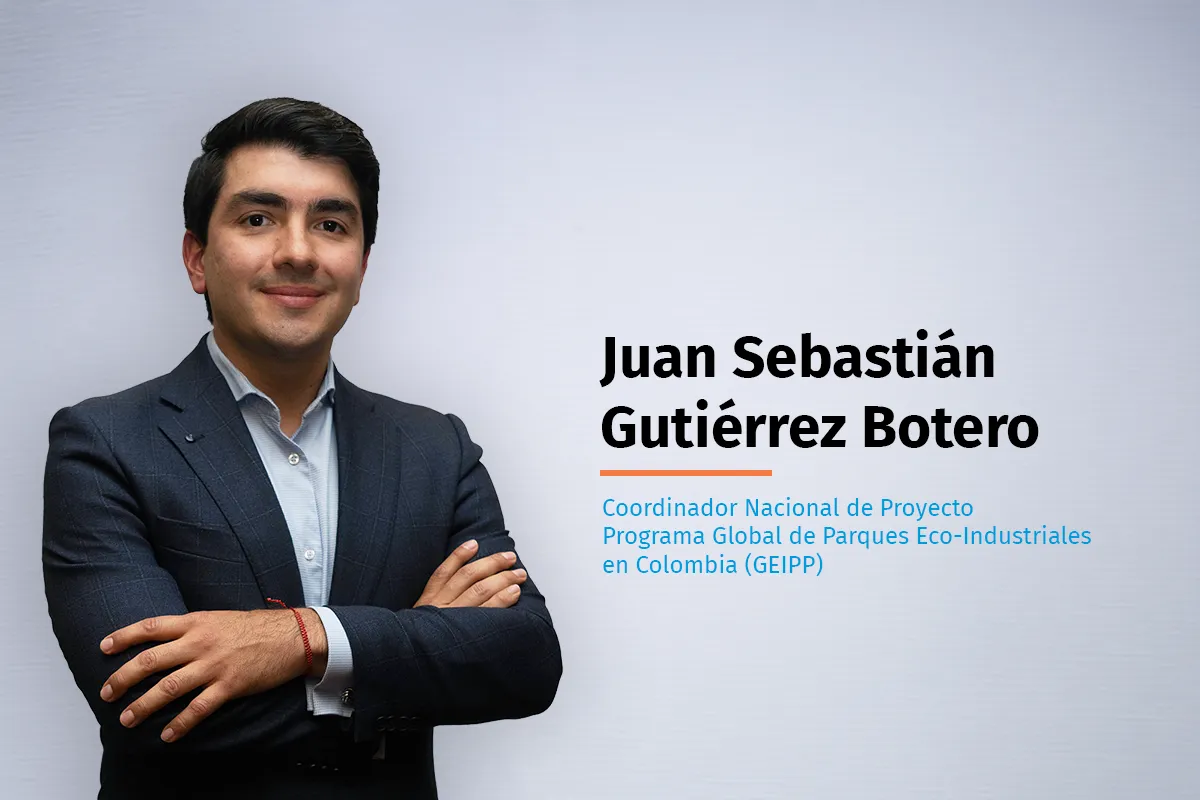
Juan Sebastián Gutiérrez National Coordinator Global Eco-Industrial Parks Programme (GEIPP) — UNIDO Colombia